

- Description
Description
solution for injection
- cows
- horses
- pigs
- sheep
Composition
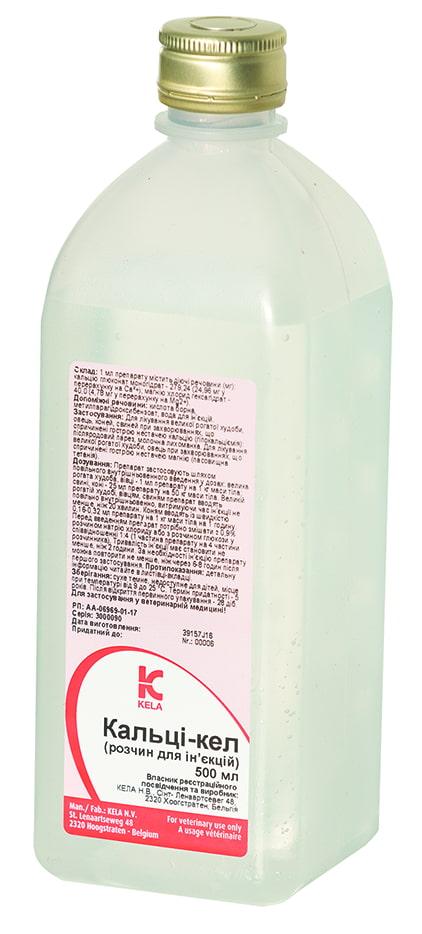
1 ml of the drug contains active substances (mg):
calcium gluconate monohydrate – 279.24 (24.96 mg in terms of Ca²+);
magnesium chloride hexahydrate – 40.0 (4.78 mg in terms of Mg2+).
The other ingredients are boric acid, methyl parahydroxybenzoate, water for injections.
Indications for use
For the treatment of cattle, sheep, horses, pigs with diseases caused by an acute lack of calcium (hypocalcemia): postpartum paresis, milk fever. For the treatment of cattle and sheep with diseases caused by an acute lack of magnesium (pasture tetany).
Pharmacological properties
ATC-vet classifier: QA12AC Calcium in combination with vitamin D and or with other veterinary drugs. The drug increases the level of ionized calcium, participates in the formation of bones and teeth, the transmission of nerve impulses necessary for the contraction of skeletal muscles, and increases the work of the heart muscle. Calcium is important in the processes of blood and milk coagulation, in the penetration of cell membranes and maintenance of acid-alkaline balance. Calcium levels in most animal species range from 9–12 mg/100 ml. Magnesium, like potassium, is the main cation of the intracellular environment. In cells, it participates in intermediate exchange as a specific activator of Krebs cycle enzymes and nucleic acids (DNA RNA polymerases, ribonucleases, deoxyribonucleases, etc.) In cell mitochondria, magnesium ions activate oxidative phosphorylation processes.
In muscle, magnesium enables actin-myosin coupling when synthesizing the protein complex required for muscle contractions. It is present in the myosin+ATP complex, where it activates primarily the cleavage of macroergic ATP bonds. This releases the energy used in muscle contraction. Magnesium affects the functions of the central nervous system by activating cholinesterase, as a result of which the breakdown of acetylcholine is accelerated. At the same time, the excitability of the nerve endings slows down and the muscles relax. With a lack of magnesium, the activity of cholinesterase decreases, the release of acetylcholine increases, due to which nervous excitability and muscle tone increase, clonic and tetanic convulsions occur. When the concentration of magnesium in the blood increases, the function of the cerebral cortex can be inhibited until the development of a narcotic state, which is characterized by the absence of reflexes and muscle paralysis. It is necessary for the formation of bone tissue, as it is part of hydroxyapatite crystals, which helps to increase the strength of bones and teeth. After intravenous administration of the drug, the concentration of calcium and magnesium in the blood increases sharply. The highest level of concentration is observed at the end of the infusion and this level is much higher than usual.
After stopping the injection within 3–24 hours, there is a rapid decrease in the level of calcium and magnesium concentration in the blood. The degree of hypercalcemia (which is a side effect) depends on the dose of the drug, the speed of administration and the level of calcium in the blood before the start of treatment. After administration of the drug, calcium is distributed mainly in the extracellular fluid, magnesium is distributed mainly intracellularly.
Dosage
The drug is used by slow intravenous administration in doses: cattle, sheep — 1 ml of the drug per 1 kg of body weight; pigs, horses — 25 ml of the drug per 50 kg of body weight. In cattle, sheep, and pigs, the drug is administered slowly intravenously, withstanding an injection time of at least 20 minutes. Horses are administered at a rate of 0.16–0.32 ml of the drug per 1 kg of body weight per 1 hour. Before administration, the drug should be mixed with 0.9% sodium chloride solution or with glucose solution in a ratio of 1:4 (1 part of the drug to 4 parts of the solvent). The duration of the injection should be at least 2 hours. If necessary, the injection of the drug can be repeated at least 6–8 hours after the first use.
Contraindications
Do not use in animals with impaired function of the cardiovascular system, thyroid gland, for intoxication with cardiac glycosides, as well as in animals with renal failure, for acidosis, after administration of a high dose of vitamin D! Do not use in foals for hypocalcaemia!
Side effect
After the introduction of the drug, due to temporary hypercalcemia, disturbances in the work of the cardiovascular system were observed. In most animals, slight tachycardia and acceleration of pulse rate were observed during the use of the drug. In some cases, symptoms of hypercalcemia were observed: pronounced tachycardia, arrhythmia and even death from heart failure. The risk of an adverse reaction increases in the case of rapid intravenous administration of the drug. During and after using the drug, cases of tremors, increased salivation, lacrimation, frequent urination and defecation, disorders of the nervous system (anorexia, loss of coordination, weakness, increased excitability) are possible. Symptoms of hypercalcaemia are observed within 6–10 hours of injection.
Special precautions for use
Before use, the bottle with the drug should be heated to a temperature of 35– 37 °C. Use only dry, sterile tools. Heart rate, heart rhythm and circulation should be monitored continuously during administration
Interaction with other means and other forms of interaction
An increased level of calcium in the blood enhances the therapeutic and toxic effect of cardiac glycosides, drugs that stimulate the sympathetic nervous system and methylxanthines (caffeine, theophylline). The drug should not be used with tetracyclines, as it reduces antibacterial activity. Do not mix with other veterinary drugs!
Overdose
With rapid intravenous administration within 6–10 hours, symptoms of hypercalcemia — tachycardia, acceleration of pulse rate may be observed.
Shelf life
5 years. After opening the initial packaging — 28 days
Packaging
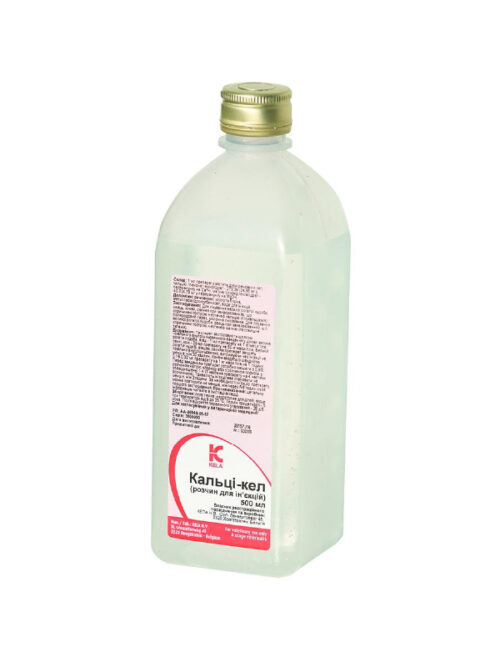
500 ml vials of polypropylene.